Showing posts with label Food geek. Show all posts

Sunday, March 30, 2014

Blood Orange Syrup & Vinegar

I was given a small bag of blood oranges and a grapefruit from a friend's yard last week. And not wanting to waste such a gift (one of my favorite aspects of living in San Diego is all the fresh fruit available for free or nearly so. More to come on that subject...) I made some blood orange syrup and with the rinds I started a batch of blood orange vinegar.

Blood Orange syrup

6-8 blood oranges
1 small grapefruit
4 key limes (or any limes)
1 cup brown sugar

I juiced all the citrus and ended up with about 400ml (about 1.75 cups). I strained the juice in to a non-reactive pan, stirred in the sugar and brought it to a boil. I simmered for 5 minutes, then strained again into small canning jars. Wiped the rims, put the lids and bands on, then processed in a water bath for 10 minutes.

AND...

*Preview of my Fermentation Class, April 17th at the Center for Living Peace, Irvine, CA*

With the citrus skins I started a batch of blood orange vinegar.

Blood Orange Vinegar

Rinds from all the citrus above
1 cup brown sugar dissolved in 3 cups of water

Pack the rinds in a large, clean glass jar. Pour over the sugar water, and add enough water to cover the rinds completely. Cover with a double piece of cheese cloth secured with a rubber band. Store in a cool dark place and check weekly. After a few days you should see bubbles when you move the jar. This means that the sugar is fermenting which is what you want. When the bubbles cease, add 1/4 cup non-pasteurized apple cider vinegar, recover with the cheesecloth and return to the cupboard. Now the alcohol will be converted in to acetic acid, aka vinegar. Filter and strain into bottles, close with a cork.

Monday, March 24, 2014

Meeting two of my idols: Alice Waters and Kermit Lynch


I had the great honor to meet two of my all time idols back in early December Chino Farms, a legendary produce stand in Rancho Santa Fe, CA. (www.facebook.com/TheVegetableShop).

Alice created the extremely influential restaurant Chez Panisse (chezpanisse.com) in Berkeley, CA back in the early 1970's. California Cuisine and the farm to table movements can both be traced back to Alice. The list of great chefs who've "graduated" from Chez Panisse is long and impressive. The food is as well. Dinner at Chez Panisse is worth the effort (reservations only, taken starting 30 days in advance) and the cost (not cheap, but also not outrageous)

Kermit is the owner of Kermit Lynch Wine Merchants (www.kermitlynch.com). He has championed small, traditional wineries producing unfiltered, not-so-international styled wines. As a personal aside, the worldwide growth of high alcohol and over-extracted wines (Do we really need a 16.6% alcohol chardonnay that will disintegrate in the bottle after about 2 years?) is one of the worst developments in my opinion in the history of wine. Even worse than White Zinfandel! The wines Kermit chooses to import are true to type, pure and yummy- The way they were meant to be! Look for his importer logo on the back labels at your local wine shop,

Chef Jeff's Online Reading List

In talking with friends over the last few weeks I thought it'd be great to put together a list of some of the resources I've found on the web for recipes, ideas and general food porn. Enjoy!

GENERAL SITES:

The amateur and professional links below provide a great deal of inspiration and information... There are some folks out there who put me to shame as far as creativity and guts in the kitchen... Homemade fish sauce??

blog.ideasinfood.com/

Saveur.com

Chefsteps.com

nordicfoodlab.org

www.punkdomestics.com

ruhlman.com

www.starchefs.com

www.americanfoodroots.com

www.thekitchn.com

www.southernfoodways.org

frombellytobacon.com

food52.com


FERMENTED/CULTURED FOODS:
With the rise in popularity of fermented foods, i.e., kim chee, sauerkraut, kombucha, yoghurt, etc. sites like these are proliferating rapidly as cooks and chefs try to regain traditions before they are lost forever. (see my Fermentation class April 17th...)

blog.culturesforhealth.com

www.fermentersclub.com/


PRESERVES:

foodinjars.com/

frombellytobacon.com

www.onetomato-twotomato.com


CURED MEATS:
A subject near and dear to my heart and belly- (see my Sausage class May 29th...)

curedmeats.blogspot.com

honest-food.net/

sausagedebauchery.blogspot.com/

frombellytobacon.com

www.onetomato-twotomato.com


BREAD & BAKING:

www.thefreshloaf.com/


COCKTAIL INGREDIENTS:
Some very in-depth and somewhat esoteric information on the ever growing world of cocktails. Plus for cooks like me, who love to "make it myself" the sites below provide very interesting "projects." Why not learn to make your own bitters, vermouth and nespolino liquer?

modernistcuisine.com/recipes/instant-infusions/

www.porkcracklins.net/2013/06/strawberry-balsamic-shrub/

boozedandinfused.com/

www.clubborgodivagli.com/content/nespolino-liquor

www.saveur.com/article/Recipes/Sotto-Chinotto

vermouth101.com/

Friday, October 18, 2013

Tapas! Spanish Vineyard Dinner begins and a note about pork

Planning is underway for next week's Spanish Vineyard dinner. We will be making and enjoying both traditional and non-traditional Tapas. The most popular legend, of course, is that tapas evolved as free nibbles in the Sherry bars of southern Spain. Others credit this King or that King. More practically they acted as a convenient "top" to keep the wine flies out of your glass. Though no longer free, tapas today consist of a wide and creative variety of small dishes, typically eaten after work with a glass of cold Fino. They serve as a much needed bridge from the usually large lunch (+ siesta!) and the very, very late dinner time (10 pm or later!) Regardless of how accurate the legends are, tapas are a wonderful and delicious culinary tradition even if they aren't really a true reflection of Spanish cuisine in general.

The common ingredients used for tapas are usually more economical cuts of meat (almost always pork, more on that in a minute), seafood and preserved products like olives, anchovies, etc.
_________________________________________________________________________


A note on the incredible amount of pork eaten in Spain: It is literally everywhere. Entire shops are devoted to Jamon, with hundreds of hams hanging from the ceiling. Even regular supermarkets carry 5 or 6 different types of Jamon. This tradition developed for a very real and serious reason, according to The Cambridge World History of Food:

"Spanish enthusiasm for pig meat stems in part from pork’s past importance as a symbol of cultural identity. Because Moors and Jews did not eat it, Christians saw the meat as more than simple nutrition. In sixteenth-century Spain, pork eating was an acid test faced by Spanish Moriscos and Marranos who publicly claimed conversion to Christianity. Conspicuous pork avoidance could result in an appearance before the tribunals of the Inquisition."
     —The Cambridge World History of Food (www.cambridge.org/us/books/kiple/hogs.htm) 

So you have to eat your pork! As my readers (both of you?) already know, fortunately for me,  I am already a huge pork fan! So the Inquisition will have to find another reason to come after me (shouldn't be too difficult)
_________________________________________________________________________

Wednesday, October 9, 2013

On to the Smoker!!

After seven days (the meat should feel firm ), take it out, rinse off all the seasonings under cold water and soak in fresh cold water for 6 hours or overnight. This helps to remove the extra salt but doesn’t remove the flavor from the cure. Drain the meat and pat it dry. If possible allow it to rest for 24 hours in the fridge on a cooling rack for better airflow. This helps the smoke really adhere to the meat.


Next mix up the dry rub for the cooking process. I like to add this to reinforce the flavors and add a gorgeous crust to the finished bacon. It’s important to be very careful with adding salt to this mix or it will be too salty. Spread the dry rub on a cookie sheet (with sides) and dredge the meat. The cookie sheet makes a great transport to the grill.


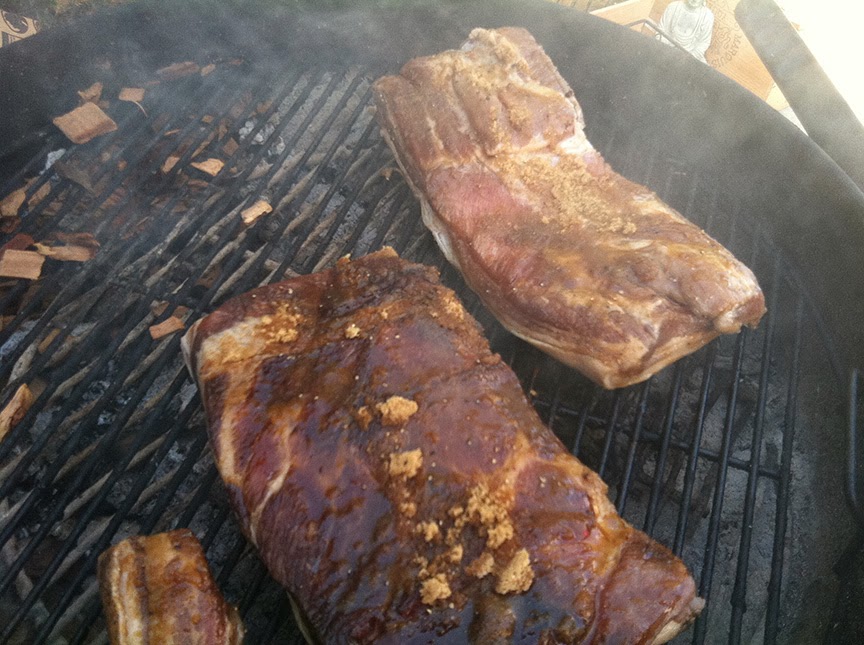
If you have a smoker or a grill, you can smoke the bacon. I use my Weber kettle grill and it works beautifully. Build a small fire with hardwood lump charcoal. When it starts to glow stir the coals so they sit deep in the grill. If you have a small grate in your grill place it TOP of the burning coals. Carefully place the tinfoil packet or the soaked woodchip on the grate,  replace the grill grate and put the bacon on keeping it away from the hottest direct heat. Cover the grill with the vents open, and let smoke for 30 minutes, checking after 15 minutes. Turn and repeat. Check the internal temperature, it should be 150º. If it isn’t and you are happy with the level of smokiness, you can cook the bacon in a 200º oven until its done.


Let it cool and refrigerate it until you’re ready to cook it. 
But I know. You won’t be able to wait. 
So cut off a piece and cook it. Taste it, savor it. 
Congratulations! It’s bacon!


Saturday, October 5, 2013

Breakfast Bacon Varieties... Including Beef Bacon

My Breakfast Bacon uses the regular dry cure with addition of additional brown sugar and blackstrap molasses. For the October 10th class I am experimenting with both pork belly and beef shortribs.. I have tried the beef bacon before but it turned out too salty, though it was remarkably bacon-like. 

I cut the ribs off (save them OF COURSE! Never throw out flavor!! Great for stock, soup, etc...). Then dredged in the cure, and into the bag with extra sugar and molasses. The meat is a little thinner than a usual pork belly so I'll cure it for only 4 or 5 days.


Here's what the finished beef bacon looked like the first time... (the photo color is a bit too red...)


Bacon Varieties...


For my "Bacon, Bacon, Bacon" class, I've decided on Sicilian and Moroccan as the two "regional flavors." Of course not much bacon is consumed in Morocco, but the spices (tumeric, garlic, sumac, za'atar, and Marrakech Moroccan Spice from Savory Spice (www.savoryspiceshop.com/blends/marr.html) are so good with grilled or smoked meats.

For the Sicilian I used garlic, oregano, dried onion, orange peel and my foraged fennel pollen. I'll do a fennel pollen foraging post later in the year. It's one of my favorite parts of living in SoCal.